Amazon SP-API vs Amazon Ads API vs MCP: Which Do You Need?
SP-API and the Amazon Ads API are separate Amazon APIs; MCP is a protocol for AI tools. Compare access, data, limits and when to use each one.
The Selling Partner API (SP-API) and the Amazon Ads API are two separate Amazon APIs, each with its own registration, permissions and data.
- SP-API covers selling operations: orders, inventory, listings, catalog, finances and reports.
- The Ads API covers advertising: campaigns, keywords, bids, budgets and ad reports.
- MCP is not a third Amazon API. It is an open protocol that lets AI applications call tools, and an MCP server can sit in front of either Amazon API or both.
So start with which Amazon data you need. Then decide who will use it: code you write, or an AI assistant such as Claude or ChatGPT.
The three side by side
| Selling Partner API | Amazon Ads API | Model Context Protocol | |
|---|---|---|---|
| What it is | Amazon's REST API for sellers' and vendors' business data | Amazon's REST API for managing advertising | An open protocol that connects AI applications to tools and data |
| Who runs it | Amazon | Amazon Ads | An open specification. Anyone can run a server. |
| Typical data and actions | Orders, inventory, listings, catalog, pricing, finances, reports | Campaigns, ad groups, keywords, targets, bids, budgets, performance reports | Whatever a server's tools expose |
| Who gets developer access | Developers who register and are approved for the roles they need | Partners and direct advertisers who apply and are approved | Anyone with an MCP client. Each server decides whom it serves. |
| How a seller grants access | Authorizes an application through Login with Amazon, or self-authorizes a private application | Authorizes an application through Login with Amazon | Signs in to the server, typically with OAuth 2.1 for remote servers |
| Permission model | Roles map to operations. Restricted roles cover personal data. | Calls are made against advertising profiles the authorizing user can access | Defined by each server |
| Regions | North America, Europe and Far East endpoints | North America, Europe and Far East endpoints | One server URL. The server routes to Amazon. |
| Throttling | Token-bucket usage plans per operation, mostly per seller and application pair | Throttled by Amazon Ads. Reports are generated asynchronously. | Inherits Amazon's limits. A server may add its own. |
| Who consumes it | Your code | Your code | An AI model, through a client such as Claude or ChatGPT |
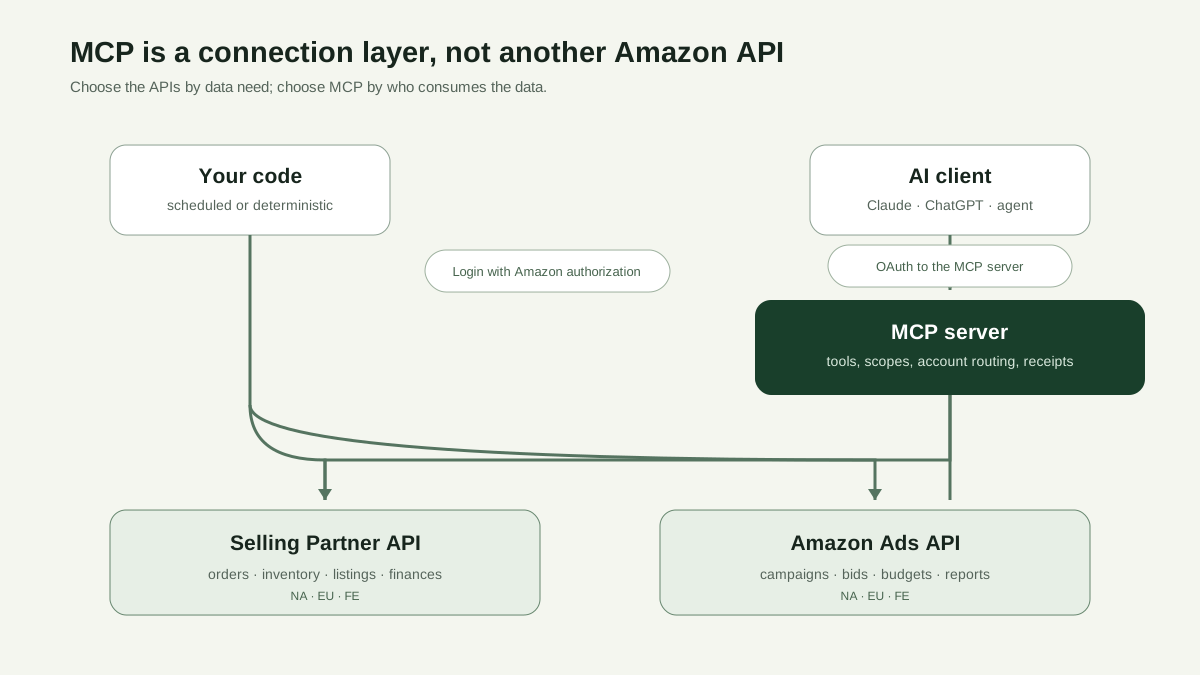
MCP changes how an AI client reaches tools; it does not replace SP-API or the Amazon Ads API underneath.
The Selling Partner API
Amazon describes the Selling Partner API as a REST-based API that lets sellers and vendors access their data. That data includes orders, shipments, payments, inventory, listings, pricing, financial transactions and reports. Developers use it to sync orders and inventory, update listings and prices, and pull financial data into their own systems.
Access has three layers.
- Roles. A developer requests roles such as Product Listing, Pricing, Inventory and Order Tracking, or Finance and Accounting. An application that calls an operation without the required role gets a 403 error. Restricted roles cover personal data and require a description of how you use and protect it. Restricted operations need a Restricted Data Token.
- Authorization. A seller authorizes a public application through an OAuth flow with Login with Amazon, which starts from the Selling Partner Appstore or the developer's website. A private application is self-authorized in Seller Central. Public applications must be reauthorized annually.
- Tokens. The application exchanges its refresh token for a Login with Amazon access token. That token expires one hour after it is issued and travels in the
x-amz-access-tokenheader on each call.
Calls go to one of three regional endpoints: North America, Europe or Far East. Rate limits use a token-bucket model. Each operation has its own rate and burst limit, and for most operations the limit applies per seller and application pair. A throttled call returns HTTP 429.
The Amazon Ads API
The Amazon Ads API is Amazon's REST API for managing advertising programmatically: campaign management, reporting, and bid, keyword and budget optimization. It spans sponsored ads, streaming TV, Amazon Marketing Cloud, Amazon Marketing Stream, and display, video and audio. Amazon says the API itself has no additional fee, though campaign costs still apply.
Access requires an application and approval. The path differs for partners, who build tools for other advertisers, and for direct advertisers, who manage their own accounts. The onboarding overview covers both. Amazon also notes that advertisers using a third-party tool built on the API do not need to request API access themselves.
Three practical differences from SP-API:
- Profiles, not roles. After a user authorizes an application through Login with Amazon, most calls name an advertising profile: one advertiser in one marketplace. The application can reach the profiles that user can access.
- Asynchronous reports. Performance reports are requested, generated in the background and then downloaded. A report is never an instant response.
- Separate hosts. The Ads API has its own North America, Europe and Far East hosts, separate from SP-API's.
What MCP adds and what it does not
The Model Context Protocol standardizes how AI applications discover and call tools on a server. MCP is useful in front of Amazon's APIs for three reasons:
- One integration works across AI clients. A server built once works in Claude, ChatGPT and other compatible clients, with no custom plugin for each.
- The model chooses the calls. You ask in plain language, and the model picks tools, fills in arguments and combines results.
- The spec builds in consent. It calls for a human in the loop who can deny tool calls, and it lets servers mark tools as read-only or destructive so clients can ask before risky actions.
MCP does not add data. It does not bypass roles, throttling or report delays. It also does not remove the need for an Amazon-authorized application somewhere in the chain. An MCP server for Amazon is a client of SP-API or the Ads API like any other.
Two sign-ins, not one
A remote MCP server for Amazon involves two separate OAuth relationships:
- The AI client and the MCP server. The MCP authorization spec has the client sign in with OAuth 2.1 and PKCE and receive a token for that server only.
- The MCP server and Amazon. The server holds its own Login with Amazon authorization.
The spec forbids passing the client's token through to the upstream API. In a well-built server, Amazon tokens never reach the AI client, and a token issued to the AI client cannot be used against Amazon directly.
Amazon also runs its own MCP server for advertising. The Amazon Ads MCP Server entered open beta on February 2, 2026. Amazon says it is available to Amazon Ads partners with active API credentials, and it exposes Ads API functionality as tools for agents such as Claude, ChatGPT and Gemini.
Which one you need: a decision framework
| Your job | Use | Why |
|---|---|---|
| Sync orders, inventory or listings with your own systems | SP-API directly | Scheduled, deterministic code. No model in the loop. |
| Apply fixed bid or budget rules across many campaigns | Ads API directly | Predictable, high-volume and fully under your control |
| Ask questions about ad performance in Claude or ChatGPT | An MCP server over the Ads API: Amazon's Ads MCP Server if you hold Ads API partner credentials, or a managed server | Natural-language analysis without writing report code |
| Ask questions that span ads and operations, such as ad spend against stock | An MCP server covering both APIs, or your own integration of both | Neither API alone has both halves |
| Let an assistant propose changes that you approve | An MCP server with server-side write controls | Confirmation is enforced by the server, not only prompted by the client |
| Build a product for other sellers | SP-API and the Ads API directly, as a registered application. You can optionally expose your own MCP server on top. | You need your own Amazon registration, roles and authorization flows |
If you are still unsure, answer three questions in order:
- Who consumes the data? If the consumer is code that runs on a schedule, call the APIs directly. If it is a person working through an AI assistant, use MCP.
- Which data? Ads data only, selling data only, or both. This tells you which APIs any route has to reach.
- Do you want to hold Amazon developer credentials yourself? If yes, build or self-host. If no, use a first-party or managed option that is the registered application for you.
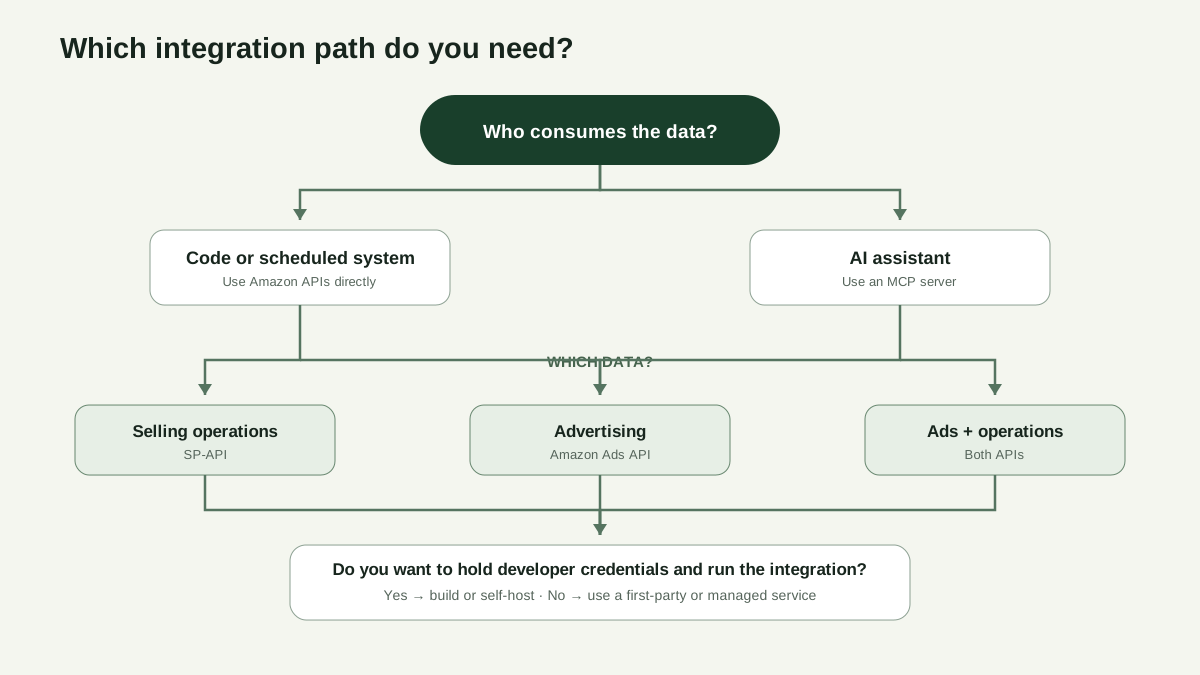
Start with the consumer and the data. Credential ownership then determines whether to build, self-host or use a managed service.
Worked example: one question that needs both APIs
Suppose you want to know: "Which advertised ASINs spent the most in the last 14 days, and are any of them low on FBA inventory?" The ad spend comes from the Ads API. The inventory comes from SP-API.
Path A: call the APIs directly.
- Get an Ads API application approved and an SP-API application with the right roles. Authorize both against your accounts.
- Request an advertised-product report from the Ads API, poll until it is ready, then download and parse it.
- Call the FBA inventory summaries operation in SP-API and page through the results.
- Join the two data sets on ASIN in your own code.
This is the most work, but you have full control and can run it on a schedule.
Path B: use an Ads-only MCP server. The model can answer the ad half: spend by advertised ASIN. For inventory you need another source, so the join happens in your head or in a spreadsheet.
Path C: use an MCP server that covers both APIs. Through Agentic Sellar, the model would typically run this sequence:
list_accountsreturns the advertising profile and the seller marketplace as separate accounts.request_ads_reportwith theadvertised_productdataset and the 14-day range returns a report ID.get_ads_reportpolls until the report is complete, then returns rows a page at a time.get_inventory_livereads current FBA inventory, one page per call. The model may need several calls for a large catalog.- The model joins the results on ASIN and answers. If you want it to, it can list ASINs such as B0EXAMPLE1 with spend and units on hand.
The trade-off is that the model does the join. Check its work on anything you will act on.
Limits that apply whichever path you choose
- Throttling. Both APIs throttle requests. An MCP server that fans out many calls hits Amazon's limits like any other client.
- Report timing and history. Ads reports are asynchronous, and attribution windows mean recent days can still change. Amazon only keeps recent report history available, so older analysis depends on data someone retained.
- Personal data. Restricted SP-API operations need restricted roles and a Restricted Data Token, whatever sits in front of them.
- Application permissions cap everything above them. An MCP server can only reach what its Amazon application is approved and authorized for.
How Agentic Sellar maps to the two APIs
Agentic Sellar is a managed MCP server and REST API that sits in front of both Amazon APIs. It is the registered Amazon application, so you authorize it on Amazon's consent screens and do not need your own developer registration. Your AI client then signs in to Agentic Sellar with OAuth. Each Amazon scope maps to one API:
| Scope | Amazon API | Example tools | Changes Amazon? |
|---|---|---|---|
ads:read | Amazon Ads API | list_ads_campaigns, request_ads_report, get_ads_report, call_ads_api_read | No |
ads:write | Amazon Ads API | update_ads_keyword_bid, update_ads_campaign_budget, update_ads_campaign_state, call_ads_api_write | Yes, each call needs confirm=true |
seller:read | Selling Partner API | get_catalog_item_live, get_order_metrics_live, get_inventory_live, list_financial_events_live, call_sp_api_read | No |
seller:write | Selling Partner API | call_sp_api_write, for workflows such as Listings Items and Feeds | Yes, each call needs confirm=true |
Two more scopes, workspace:read and workspace:write, cover the Agentic Sellar workspace itself: onboarding and Amazon connection flows, usage, billing, and retained-data product settings.
The curated advertising tools cover Sponsored Products. Other endpoints go through the general tools: the read tools send GET requests, and any other method goes through the write tools under the same scope and confirmation rules and within what the connected Amazon application can reach. Live reads return what Amazon returns at request time, and retained history requires a Data plan.
The complete operation list is in supported Amazon data and tools, and permissions and scopes explains grants and confirmation. For a weekly advertising routine built on these tools, see Amazon PPC automation with approval. For the product overview, see the Amazon Seller Central MCP server page.
Sources
- What is the Selling Partner API?
- Authorize Selling Partner API applications
- Roles in the Selling Partner API
- Connecting to the Selling Partner API
- Selling Partner API endpoints
- SP-API usage plans and rate limits
- Amazon Ads API overview
- Amazon Ads API onboarding overview
- Amazon Ads MCP Server open beta announcement
- Model Context Protocol specification (2025-11-25)
- MCP specification: Authorization