AI Tools for Amazon Sellers: How to Choose by Job and Access
The four kinds of AI tool for Amazon sellers, which jobs each fits, what each can read or change in your account, and what to check before you connect one.
"AI tools for Amazon sellers" covers four different kinds of product: AI built into Amazon, seller suites with AI features, specialist tools for ads or pricing, and connectors that let ChatGPT, Claude or another AI client you already use work on your own Amazon data. They differ less by brand than by what they can see, what they can change and who holds your Amazon authorization. This guide sorts them by job and by access, and ends with a checklist to run before any of them touches your account.
Tools are listed alphabetically within each group; nothing here is a ranking, and we leave out prices. Descriptions come from each company's public pages, checked October 30, 2026.
The short answer: choose by job, then by access
Start with the job, not the vendor:
- Writing or fixing listing content: start with the AI features already in Seller Central, then compare suites if you need keyword research alongside.
- Product and market research: seller suites and market-intelligence tools, which estimate demand across the whole marketplace rather than only your account.
- Running ads or prices continuously: specialist tools that act on goals or rules you set.
- Asking questions across your own Ads and Seller Central data, in the AI client you already use: connect that client to Amazon through MCP, the open protocol AI apps use to call outside tools.
Then check access. A tool that can change bids, prices or listings needs clear approval rules, an activity log and a way to revoke it, whoever makes it.
The four kinds of AI tool for Amazon sellers
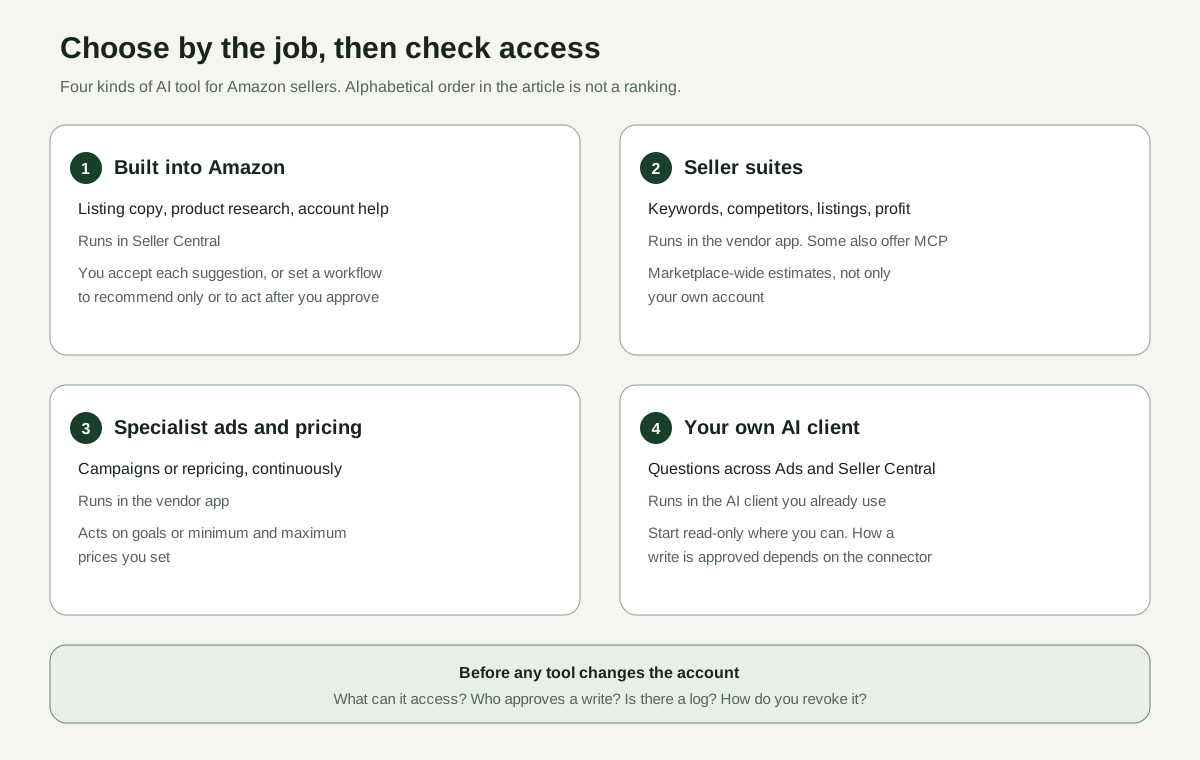
Start with the job. Then check what the tool can see, what it can change, and how you revoke it. The order inside each group is alphabetical, not a ranking.
1. AI built into Amazon
Amazon offers its own AI features for sellers:
- Enhance My Listing. Amazon describes it as generating recommendations for titles, attributes, descriptions and other details on live listings. Sellers review, customize, accept or decline each suggestion. A related tool drafts new listings from a few words, an image or a website URL.
- Product Opportunity Explorer. A research tool for trends in customer searches, purchases, reviews and pricing. Amazon says its AI capabilities recommend similar but distinct products and include Unmet Demand Insights.
- Seller Assistant. Amazon's assistant inside Seller Central. Amazon says it recommends on inventory, advertising and compliance, and acts with your permission. Workflows run continuously within guardrails you set. You choose recommend-only or act, approve actions before they run, and actions are logged.
Fits: sellers who want help inside Seller Central and don't need data from other sources.
2. All-in-one seller suites with AI features
These suites started as research and listing tools and have added AI assistants. Several now offer MCP access as well:
- Helium 10. Tools for Amazon, Walmart and TikTok Shop: keyword and product research, listings, ads with rules-based bidding, and profit and inventory. Helium 10 describes an AI agent, Helium, and an MCP that connects its data to Claude, ChatGPT or other models.
- Jungle Scout. Amazon market data for brands and sellers: sales estimates, category benchmarking, and pricing and advertising performance. It offers Catalyst for new and growing sellers and a Jungle Scout MCP for AI workflows.
- SmartScout. Market intelligence that maps brands, third-party sellers, subcategories and products. It also includes AI listing tools and an AI Visibility Monitor that tracks which sources ChatGPT, Perplexity and AI Overviews cite for a category.
Fits: research, keyword and competitor work, where marketplace-wide estimates matter more than your own account data.
3. Specialist AI tools for ads and pricing
These tools do one operational job continuously:
- Perpetua. Advertising software for Amazon, Walmart and other marketplaces. You set goals such as growth, profitability or brand defense, and its engine creates and optimizes campaigns.
- Seller Snap. An AI repricer for Amazon and Walmart. Seller Snap says it uses game-theory logic to compete for the Buy Box without simply undercutting, working within the minimum and maximum prices you set.
- Teikametrics. A marketplace optimization platform for Amazon, Walmart and TikTok Shop. Teikametrics describes full-funnel advertising, Amazon Marketing Cloud audience insights, generative-AI listing edits, an ARI Assistant chat, and optional managed services.
Fits: sellers who want a tool to act inside clear limits, on a schedule, without being asked each time.
4. Your own AI client connected to Amazon data
Here the AI is the general-purpose client you already use, such as Claude, ChatGPT or Amazon Quick. A connector gives it tools for reading, and sometimes changing, your Amazon accounts. If MCP is new to you, start with what an Amazon Seller Central MCP server is.
- Agentic Sellar (our product). A managed MCP server for Seller Central and Amazon Ads, used from your MCP-compatible AI client. Details are in the table and the last section.
- Amazon Ads MCP Server. Amazon announced an open beta on February 2, 2026. Agents such as Claude, ChatGPT or Gemini can create, update or delete campaigns, run reports, manage settings and reach billing data. It covers Ads only, for partners with active API credentials.
- Amazon Selling Partner plugin. It brings Seller Assistant and Seller Central data (listings, metrics, inventory and sales) into Amazon Quick and, in beta, Claude. Amazon says actions need human approval and are logged. Beta for US stores. Claude lists separate read-only and write tools.
- Seller Labs Amazon MCP. Seller Labs says Claude, ChatGPT and other clients get reconciled Seller Central and Ads data, including SKU profit after fees and returns, with up to two years stored from the day you connect. Writes are logged; high-risk ones warn first.
Fits: sellers and agencies who already work in an AI client and want it to use live account data.
Comparison table
Each row reflects the vendor's or Amazon's own public description as of October 30, 2026. "Not stated" means the page we checked did not say.
| Group | Tool | Main jobs | Amazon data it works with | Where the AI runs | How changes are approved |
|---|---|---|---|---|---|
| 1 | Enhance My Listing | Listing content | Your listings | Seller Central (Manage All Inventory) | You accept, edit or decline each suggestion |
| 1 | Product Opportunity Explorer | Product research | Amazon customer search, purchase, review and pricing trends | Amazon's seller tools | Research only; no account changes described |
| 1 | Seller Assistant | Account help, inventory, ads, compliance | Your Seller Central account | Seller Central | You choose recommend-only or act; you approve actions before they run; actions logged |
| 2 | Helium 10 | Keywords, research, listings, ads, profit | Amazon, Walmart and TikTok Shop data | Helium 10 app, or your AI client through its MCP | Ads use rules-based bidding; approval for AI-made changes not stated |
| 2 | Jungle Scout | Market data, benchmarking | Marketplace-wide Amazon estimates | Jungle Scout apps, or your AI client through its MCP | Not stated |
| 2 | SmartScout | Market intelligence, listings | Marketplace-wide brand, seller and subcategory data | SmartScout app | Not stated |
| 3 | Perpetua | Advertising | Ads on Amazon, Walmart and other marketplaces | Perpetua app | Engine acts against goals you set |
| 3 | Seller Snap | Repricing | Your offers on Amazon and Walmart | Seller Snap app | Reprices automatically within your minimum and maximum |
| 3 | Teikametrics | Ads, AMC insights, listings | Amazon, Walmart and TikTok Shop | Teikametrics app, optional managed service | Not stated |
| 4 | Agentic Sellar | Questions and approved changes across Ads and Seller Central | The Seller Central and Amazon Ads accounts you connect | Your MCP-compatible AI client | Read-only by default; each write needs a write scope and explicit confirmation; every call leaves a receipt |
| 4 | Amazon Ads MCP Server | Ads operations and reporting | Amazon Ads | Your agent or AI platform | Its Sponsored Products campaign tool produces a campaign that "only needs review and approval" |
| 4 | Amazon Selling Partner plugin | Seller Assistant in your AI client | Seller Central, US stores (beta) | Amazon Quick; Claude (beta) | Human approval on actions; audit trail |
| 4 | Seller Labs Amazon MCP | Reconciled data, profit, campaign changes | Seller Central and Amazon Ads | Claude, ChatGPT and other MCP clients | Writes logged; warnings on high-risk actions |
If you would rather build your own connection, SP-API vs Ads API explains which Amazon API holds which data.
Which tool fits which job
| Job | Where to start | What to watch |
|---|---|---|
| Fix or refresh listing copy | Group 1 (Enhance My Listing), then group 2 if you also need keyword research | Review every suggestion; listing claims are your responsibility |
| Find new products | Group 1 (Product Opportunity Explorer) or group 2 | Third-party sales figures are estimates |
| Understand why ad spend rose | Group 4, or the reporting in groups 2–3 | Amazon's report delays and attribution windows apply to every tool |
| Change bids, budgets or negatives | Group 3 for continuous automation; group 4 for changes you approve one at a time | Decide in advance which changes need your sign-off |
| Reprice against competitors | Group 3 | Set floors and ceilings you are comfortable with |
| Combine ad data with inventory or sales | Group 4 tools that reach both Ads and Seller Central | Check which Amazon APIs the tool can actually reach |
| Ask anything in the AI client you already use | Group 4 | Check how your client asks for approval before writes |
Using ChatGPT or Claude with your own Amazon data
A general AI client knows nothing about your account until something connects it. With a remote MCP server you sign in through OAuth under the MCP authorization spec, so the client receives a token, not your password. There are four routes:
- Amazon's Selling Partner plugin for Seller Central in Amazon Quick or Claude, if you sell in the US stores it covers today.
- The Amazon Ads MCP Server for advertising work, if you are an Amazon Ads partner with API credentials. Our Amazon Ads MCP Server alternative guide compares it with a server that also covers Seller Central.
- A managed MCP server, such as Agentic Sellar or Seller Labs, that holds the Amazon authorization for you and works with several clients.
- Building your own on Amazon's APIs, if you have developers and want full control.
Setup differs by client. To set one up, see connect Claude to Amazon Seller Central and connect ChatGPT to Amazon Seller Central. Every supported client is on the AI integrations for Amazon sellers page.
What to check before an AI tool touches your account
Ask these questions about any tool in any group:
- What does it ask for? A scoped sign-in through Amazon's own consent screen is very different from a password. Amazon's Acceptable Use Policy bars API solution providers from requesting Seller Central usernames or passwords.
- Can it be read-only? Start there, and add write access only for the jobs that need it.
- Who approves changes? Find out whether each write needs your confirmation, follows rules you set, or happens automatically.
- Is there a record? Look for a log of what the tool did, on which account, and when.
- How do you revoke it? You should be able to cut access from the tool and from Amazon without contacting support.
- Does it identify itself as automated? Amazon said Business Solutions Agreement updates effective March 4, 2026 add an Agent Policy: AI agents must identify themselves as automated, comply with the policy and stop access if Amazon asks. Read the full policy in Seller Central before any agent works on your account.
For a deeper method, see how to give an AI agent access without sharing credentials.
A worked example: a question that needs Ads and Seller Central data
Take one question: "Which of my advertised products are close to running out of stock, and how much am I spending on them?"
It needs two Amazon sources: ad spend from Amazon Ads and inventory from Seller Central.
- Group 1: Amazon describes Seller Assistant as covering both inventory and advertising strategy inside Seller Central. Check its answer against your campaign reports.
- Groups 2 and 3: it depends on which Amazon connections the tool uses and you have granted. Check its documentation.
- Group 4: it depends on what the connector reaches. The Amazon Ads MCP Server covers the ads half only. Amazon describes the Selling Partner plugin in terms of Seller Central data such as inventory and sales. A connector that reaches both can answer the whole question in one conversation.
With Agentic Sellar, your AI client can read Sponsored Products campaigns and request ad reports from Amazon Ads, read inventory from the Selling Partner API, then propose bid or budget changes that each need explicit confirmation. Whatever the tool, confirm it reaches both sources before trusting a combined answer.
Where Agentic Sellar fits, and where it doesn't
Agentic Sellar is a managed Amazon Seller Central MCP server for Seller Central and Amazon Ads. It fits sellers and agencies who want to work in their own MCP-compatible AI client, with one connection covering both Amazon sources. Claude and ChatGPT are among those clients, and each has its own setup page.
What it does:
- AI clients sign in with OAuth 2.1 and PKCE. No API key or LLM key is pasted into the AI tool.
- Amazon refresh tokens stay on Agentic Sellar's servers, encrypted at rest with AES-256-GCM. AI clients get their own short-lived credentials and never see Amazon credentials.
- New connections get read scopes only. Write tools need a write scope plus an explicit confirmation on every call, and every call that passes access checks leaves a receipt.
- A connection lasts at most 30 days and can be revoked at any time from the Agent access page.
- Agentic Sellar supports Seller Central and Amazon Ads connections across Amazon's North America, Europe and Far East regions. Each region requires its own Amazon authorization, and available APIs remain subject to the application's Amazon permissions.
- On Data plans, it can query retained campaign, ad, product, revenue, cost and fee history. Agentic Sellar can request up to 93 days of Sponsored Products reporting history when Amazon makes it available. Other advertising formats may have shorter windows, and retained history begins when collection is enabled.
- To protect sellers from runaway agent loops, Agentic Sellar limits Amazon-account tool calls to 120 per minute per workspace, shared across its connected AI clients. Plan concurrency and usage allowances, and Amazon's own API throttles, also apply.
What it doesn't do:
- It does not choose bids or budgets on its own. Changes come from your AI tool, and how that tool asks for approval depends on the client.
- Live reads return what Amazon's APIs return at request time, so Amazon's report delays and attribution windows still apply.
- It does not run inside Seller Central the way Amazon's own AI does. If you only need help there, start with group 1.
- If your work is Ads-only and you are an Amazon Ads partner, Amazon's Ads MCP Server is the first-party option.
- Agentic Sellar is independent and is not affiliated with or endorsed by Amazon, Anthropic or OpenAI.
The security details are in Agentic Sellar's security model.
Frequently asked questions
Is it allowed to use AI agents on Seller Central?
Amazon's Agent Policy, added with the Business Solutions Agreement updates effective March 4, 2026, sets requirements for AI agents: they must identify themselves as automated, follow the policy and stop access if Amazon asks, and Amazon says it may restrict their access in some cases. Read the policy in Seller Central, and prefer tools that use Amazon's authorization flow over ones that ask for your login.
Does Amazon have its own AI tools for sellers?
Yes: Seller Assistant, Enhance My Listing and Product Opportunity Explorer, plus the Selling Partner plugin and the Amazon Ads MCP Server for outside AI tools.
Can ChatGPT or Claude change my bids?
Only if a connected tool gives it write access. With MCP connectors, check whether writes are off by default, whether each change needs your confirmation, and whether there is a log. See Amazon PPC automation with approval for one approval-first routine.
Do I need to be a developer?
Not for groups 1 to 3 or the managed connectors in group 4. Building your own connection on Amazon's APIs does.
Sources
- Amazon: Seller Assistant (Amazon Selling Partners)
- Amazon: Seller Assistant and the Selling Partner plugin for Amazon Quick and Claude
- Amazon: Product listings with gen AI and Enhance My Listing
- Amazon Seller Forums: New AI tool helps you optimize existing product listings
- Amazon: Enhance My Listing announcement
- Amazon Ads: Introducing the Amazon Ads MCP Server (open beta)
- Claude connector directory: Amazon Selling Partner
- Amazon Seller Forums: Business Solutions Agreement updates effective March 4, 2026
- Amazon Acceptable Use Policy (Amazon Services API)
- Helium 10
- Jungle Scout
- SmartScout
- Perpetua
- Seller Snap
- Teikametrics
- Seller Labs Amazon MCP
- MCP specification: Authorization (2025-11-25)