Amazon Ads MCP Server Alternative: When You Also Need Seller Central
Amazon's Ads MCP Server reaches only the Ads API. Compare access, sign-in, accounts and write controls with a managed MCP server that also covers Seller Central.
The Amazon Ads MCP Server is Amazon's own MCP server for the Amazon Ads API, and for advertising-only work it is the first-party option to try first. It does not reach the Selling Partner API, so it cannot answer the Seller Central half of a question: total sales, FBA inventory, orders or fees. You need an alternative, or a second connection, when your questions span ads and selling data, or when you would rather not register and maintain your own Ads API application. A managed MCP server such as Agentic Sellar covers both APIs behind one OAuth sign-in.
The facts about Amazon's products below come from Amazon's own pages as of October 19, 2026. Where Amazon has not published something, we say so. For how the two Amazon APIs differ, see SP-API vs the Amazon Ads API vs MCP.
What the Amazon Ads MCP Server is
Status and access
Amazon announced the Amazon Ads MCP Server in open beta on February 2, 2026, and says it is available globally to Amazon Ads partners with active API credentials. We found no general-availability announcement as of October 19, 2026.
The OAuth connection guide lists the prerequisites: an Amazon developer account, an approved application with Amazon Ads API access, and that application's Login with Amazon client ID. Amazon's Ads API overview says direct advertisers can also register for API access to their own accounts, but Amazon does not say whether that qualifies them for the MCP beta.
How you connect
Amazon Ads hosts and maintains the server, with separate URLs for North America, Europe and the Far East (connection guide). There are two ways to sign in:
- Token in the configuration. You paste a Login with Amazon access token and your client ID into the AI client's configuration as headers.
- OAuth 2.1. The AI client opens a Login with Amazon page in your browser. As a public client (client ID only), the access token expires after an hour and you sign in again. As a private client (client ID and secret), the refresh token is kept in your system keychain or a credentials file and refreshes automatically.
For OAuth, you first add each client's callback URL to your application's allowed return URLs. Amazon lists them for Kiro CLI, Claude Code, Claude Desktop, ChatGPT and Amazon Quick. In Claude Desktop, the server becomes a custom connector with your client ID and secret.
Tools and accounts
Amazon's overview describes tools, plus skills: prompts from Amazon Ads that guide workflows. Standard tools are deterministic actions such as campaign performance, account lists, invoices, reports and budget changes. The announcement adds workflows for end-to-end Sponsored Products campaigns and expansion to new countries. Expert tools apply Amazon-side inference; the first, the AMC SQL Generator, is in closed beta. A Lite endpoint offers the same operations through three meta-tools to save model context.
Amazon's public pages do not list the full tool catalog. By default, the model supplies an account identifier on each call, which can be a profile, a manager account, a DSP advertiser or an AMC instance. In header-based setups, a fixed mode pins every request to one account.
Where the Selling Partner plugin fits
On September 23, 2026, Amazon announced the Amazon Selling Partner plugin. It brings Seller Assistant into Amazon Quick and, in beta, Claude, for sellers in Amazon's US stores, with international expansion to follow. Amazon says it connects listing contributions, real-time performance metrics, inventory levels and sales analytics, and that it can act as well as read, with human approval and audit trails. Advertising data is not on that list, and Amazon does not call the plugin an MCP server. So Amazon now has a first-party route for each half of the business.
Side-by-side comparison
This table uses only the Amazon pages in the sources and Agentic Sellar's published product facts. "Not published" means we could not find it on Amazon's pages as of October 19, 2026.
| Amazon Ads MCP Server | Amazon Selling Partner plugin | Agentic Sellar (managed MCP server) | |
|---|---|---|---|
| Status | Open beta since February 2, 2026 | Beta, announced September 23, 2026 | Paid plans available |
| Amazon data | Amazon Ads API only | Listings, performance, inventory and sales analytics. Advertising not listed. | Amazon Ads API and Selling Partner API |
| Who can use it | Ads partners with active API credentials, per Amazon | Sellers in Amazon's US stores | Sellers and agencies. A workspace owner authorizes each AI connection. |
| Your own Amazon developer application | Required | Not published. Amazon says Claude setup needs no coding. | Not required. Agentic Sellar is the registered application. |
| How the AI client signs in | Access token in headers, or OAuth 2.1 through Login with Amazon with your client ID | Not published | OAuth 2.1 with PKCE (S256) and dynamic client registration. No client ID or API key to paste. |
| Who holds the Amazon credentials | You: the client's configuration, your keychain or a credentials file | Not published | Agentic Sellar's servers, encrypted at rest. The AI client gets its own short-lived token. |
| Account selection | The model supplies account IDs, or headers fix one account | Not published | The owner picks accounts on the consent screen, or allows all workspace accounts |
| Write controls | Client-side tool filtering documented. Server-side confirmation not published. | Human approval on actions, per Amazon | Write scope, plus confirm=true on every write call |
| Audit record | Not published | Audit trails, per Amazon | A receipt for each call that passes access checks |
| Regions | Separate NA, EU and FE URLs | US stores. International expansion planned. | NA, EU and FE, one Amazon sign-in per region |
| AI clients named | Claude, ChatGPT, Gemini, Kiro, Amazon Bedrock, Amazon AgentCore, other MCP clients | Amazon Quick, and Claude in beta | Claude, ChatGPT (depends on plan), Claude Code, other OAuth MCP clients |
| Rate limits | Not published | Not published | 120 tool calls a minute per workspace, plus plan limits |
| Price | Not published. No additional Amazon Ads fee for the Ads API itself. | Not published. Free 12-month Quick Plus offer through December 31, 2026. | Access $59 a month (early-adopter price). Data plans from $149 a month. |
Three differences matter most in practice.
- Coverage. Amazon's server goes deeper on advertising, with DSP and AMC account types, campaign-building workflows and an AMC expert tool. Agentic Sellar reaches both APIs: curated tools for Sponsored Products and common Seller Central reads, plus general tools for other endpoints its application can reach (supported Amazon data and tools).
- Who holds the keys. With Amazon's server, no third party sits between you and Amazon, but you maintain the Ads API application, callback URLs and tokens yourself. A managed server holds the Amazon refresh token for you, so you are trusting the provider. Run the checklist in our Seller Central MCP server guide first.
- Where writes are gated. Amazon's server can create, update and delete campaigns, and its docs show removing delete tools in the client. Agentic Sellar enforces write scopes and
confirm=trueon the server. Its general write tool can still reach any mutating endpoint the application allows, so those checks are the real control (permissions and scopes).
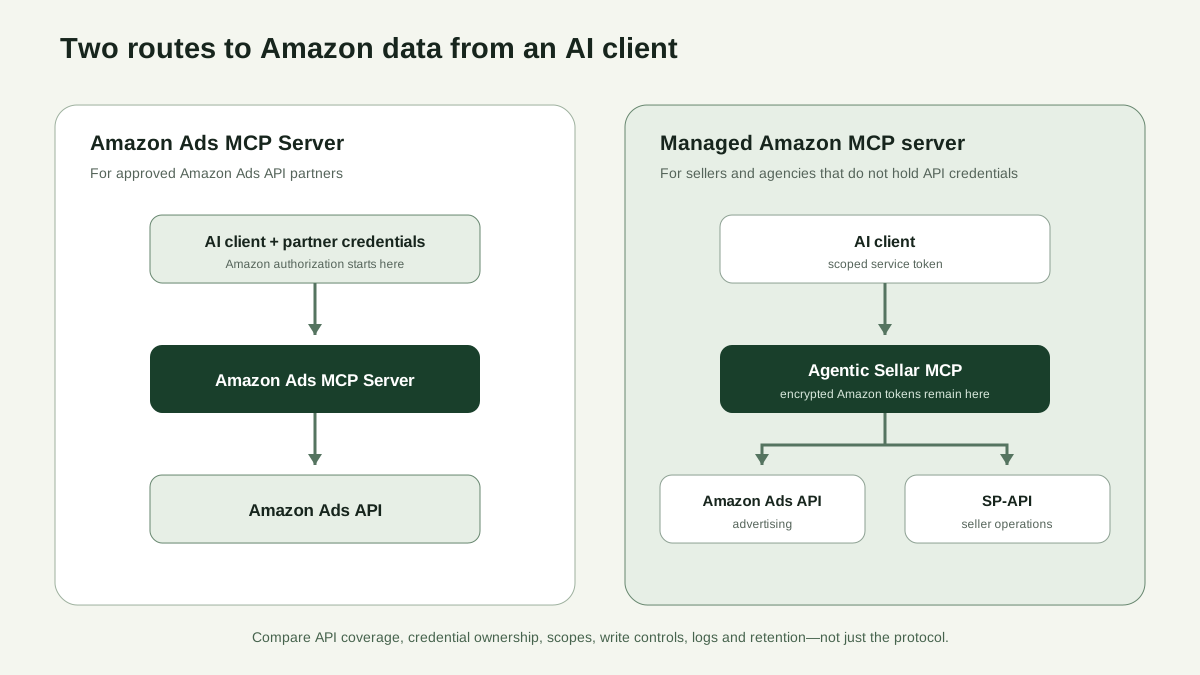
The options differ most in API coverage and who owns the Amazon developer credentials, not in the MCP protocol itself.
Worked example: a question that needs both APIs
"In the US marketplace over the last 30 days, what was our TACoS, and which five Sponsored Products campaigns drove most of the spend?"
TACoS is ad spend divided by total sales. Spend comes from the Amazon Ads API. Total sales, organic included, come from the Selling Partner API, because ads reports count only sales attributed to ads.
Route 1: the Amazon Ads MCP Server alone
It answers the advertising half. The model looks up the account (account_management-query_advertiser_account in Amazon's docs), runs a campaign performance query or report, and ranks the campaigns. It cannot return total sales, so you bring that number from Seller Central yourself.
Route 2: both Amazon tools in one client
A US seller in Claude could connect the Ads MCP Server and the Selling Partner plugin side by side. The plugin lists sales analytics among its data, so it may supply the sales half. We have not tested whether it returns total sales for any 30-day range you choose.
Route 3: a managed server that covers both
Through Agentic Sellar, the connection needs ads:read and seller:read, and no write scope. The model would typically run:
list_accounts, which returns the US advertising profile and the US seller account as separate account IDs.request_ads_reportwith thecampaigndataset, the advertising account and the 30-day range, which returns a report ID.get_ads_report, which polls until the report is complete and then returns rows a page at a time.get_order_metrics_livewith the seller account and the same range, which returns daily order count, units and total sales.- The model sums the spend, divides by total sales and ranks the campaigns.
Two cautions. The curated report covers Sponsored Products only, so the answer excludes Sponsored Brands and Sponsored Display spend. And attribution windows mean recent days of ad data can still change, so check the model's numbers before acting on them.
When to choose which
Choose the Amazon Ads MCP Server when your work is advertising only, you already hold an approved Ads API application or build for clients as an Ads partner, you want Amazon-maintained workflows such as campaign creation or AMC query generation (in closed beta), or you would rather no third party held your Amazon tokens.
Choose a managed server that also covers Seller Central when:
- your questions join ad data with sales, inventory, orders or fees
- you do not want to register and maintain an Amazon developer application
- you want per-account grants, server-enforced write confirmation and a receipt for every call that passes access checks
- you use AI tools other than Quick and Claude, or sell outside the US stores the plugin covers today
Use both when your advertising work needs Amazon's own build tools and your reporting needs Seller Central data. An agency might launch campaigns through Amazon's server and run cross-account reporting through a managed server.
Consider the Selling Partner plugin if you are a US seller working in Quick or Claude and want Seller Assistant's recommendations and actions on listings, inventory and pricing.
What we could not confirm
As of October 19, 2026, Amazon's pages did not answer these questions:
- whether direct advertisers, not only partners, qualify for the Ads MCP Server beta
- what the Ads MCP Server costs, during or after the beta
- its rate limits or history window. Some third-party pages quote a number of days of history, but Amazon's MCP pages give none.
- the full tool catalog, which needs a connected client to list
- how the Selling Partner plugin authenticates, and whether it exposes any advertising data
Where Agentic Sellar fits
Agentic Sellar is a managed option for sellers and agencies who want Amazon Ads and Seller Central in the AI tool they already use, without their own Amazon developer registration. It does not choose bids or budgets on its own, and it is independent, not affiliated with or endorsed by Amazon, Anthropic or OpenAI. If your work is advertising only and you already hold Ads API credentials, start with Amazon's server. Coverage, pricing and the security model are on the Amazon Seller Central MCP server page.
Sources
- Amazon Ads: Introducing the Amazon Ads MCP Server (open beta announcement)
- Amazon Ads MCP Server: Overview
- Connecting to the Amazon Ads MCP Server
- Connecting to the Ads MCP Server using OAuth 2.1
- Connecting to the Amazon Ads MCP Server (Lite)
- Amazon Ads MCP Server: AMC SQL Generator
- Amazon Ads API overview and FAQ
- Amazon: Seller Assistant and the Selling Partner plugin for Amazon Quick and Claude