Amazon Seller Central MCP Server: What It Is and How It Works
What an Amazon Seller Central MCP server does, how a tool call travels from Claude or ChatGPT to Amazon's APIs, and what to check before you connect one.
An Amazon Seller Central MCP server turns Amazon's seller APIs into tools an AI assistant can call. On one side it uses the Model Context Protocol. On the other it calls the Selling Partner API and, often, the Amazon Ads API. Claude, ChatGPT or another MCP client can then read your orders, inventory, listings and ad performance, and change them if you allow it. The server holds the Amazon authorization. It decides which accounts and actions each AI connection may use, and it turns each tool call into an Amazon API request.
This guide follows a single tool call from your prompt to Amazon and back. It then compares the ways to get a server in 2026 and lists what to check before you connect one to a seller account. For setup steps in a specific AI tool, see the guides for connecting Claude to Amazon Seller Central and connecting ChatGPT to Amazon Seller Central.
What MCP is
MCP is an open protocol that standardizes how AI applications connect to outside data and tools. The specification defines three roles:
- Host: the AI application, such as Claude.
- Client: the part of the host that manages one connection.
- Server: the program that provides capabilities.
A server can offer resources, prompts and tools. For Amazon work, tools matter most. A tool is a named function with a JSON Schema for its inputs, and the model decides when to call it.
Messages use JSON-RPC 2.0. A local server runs on your machine over the stdio transport. A remote server runs on the internet over Streamable HTTP. For remote servers, the MCP authorization spec builds on OAuth 2.1. You sign in through your browser, and the AI client receives a token rather than a password.
What a Seller Central MCP server does
Whoever builds it, a Seller Central MCP server has four jobs.
- Publish tools. The client sends a
tools/listrequest. The server answers with tools such as "list current campaigns" or "read FBA inventory". Each tool has an input schema and a description the model reads to decide when to use it. - Hold the Amazon authorization. A seller authorizes a Selling Partner API application through Login with Amazon, Amazon's OAuth service (how SP-API authorization works). The application then uses a long-lived refresh token to get short-lived access tokens. Someone has to keep that refresh token safe. With a hosted server, the server keeps it, not the AI client.
- Enforce permissions. The server decides which Amazon accounts and which actions an AI connection may use. This is separate from what the Amazon application itself is allowed to do.
- Shape requests and responses. Amazon's APIs paginate, throttle requests, and generate advertising reports asynchronously. The server turns those patterns into calls a model can handle: bounded pages, report polling and readable errors.
Typical tools and the Amazon APIs behind them
Here is how common requests map to Amazon's APIs, with the tool Agentic Sellar uses for each. Other servers name their tools differently but cover similar ground.
| What you ask for | Amazon API underneath | Example tool | Changes Amazon? |
|---|---|---|---|
| Current campaigns, ad groups and keywords | Amazon Ads API | list_ads_campaigns, list_ads_keywords | No |
| Campaign, keyword or search-term report | Amazon Ads API (asynchronous reports) | request_ads_report, then get_ads_report | No |
| Keyword bid or daily budget change | Amazon Ads API | update_ads_keyword_bid, update_ads_campaign_budget | Yes, with confirmation |
| Catalog details for an ASIN | Selling Partner API | get_catalog_item_live | No |
| Order metrics and FBA inventory | Selling Partner API | get_order_metrics_live, get_inventory_live | No |
| Posted financial events | Selling Partner API | list_financial_events_live | No |
| Listings or feeds changes | Selling Partner API | call_sp_api_write | Yes, with confirmation |
Agentic Sellar's full tool list, with the permission each tool needs, is in supported Amazon data and tools.
What happens when Claude calls a tool
This example uses Agentic Sellar because we can describe its implementation exactly. Other servers differ in the details, but they solve the same problems.
Connecting for the first time
- You add
https://agenticsellar.com/mcpto Claude as a custom connector. - Claude's first request carries no token. The server answers
401 Unauthorizedwith aWWW-Authenticateheader that points to its protected resource metadata, as the MCP authorization spec requires. - Claude reads that metadata and finds the authorization server. It registers itself through dynamic client registration, then opens a browser sign-in using the authorization code flow with PKCE.
- A workspace owner signs in to Agentic Sellar and chooses which Amazon accounts the connection can use. The consent screen also shows whether Claude is asking for write access.
- Claude receives its own access token, valid for 60 minutes, and a refresh token. The connection lasts at most 30 days. Amazon credentials are never part of this exchange.
Making a call
Say you ask: "Which Sponsored Products campaigns spent the most in the last 7 days?"
- Claude chooses a tool. First it calls
list_accountsto get the account ID. Then it picksrequest_ads_reportwith thecampaigndataset, that account ID and the date range. - The request reaches the server. Claude sends a JSON-RPC
tools/callmessage to the MCP endpoint as an HTTPS POST, with its bearer token. - The server checks the caller. It:
- validates the token
- confirms the connection holds
ads:read - confirms the account is one the owner granted
- checks the plan and rate limits
- records a receipt for the call
- The server calls Amazon. It loads the stored Amazon Ads authorization for that account and gets a short-lived Amazon access token. Then it sends the report request to the regional Amazon Ads host for that advertising profile.
- Amazon answers asynchronously. Amazon builds Ads reports in the background, so the tool first returns a report ID. Claude calls
get_ads_reportto check on it. Once the report is complete, the server returns a bounded page of rows. - Claude answers you. It ranks the campaigns from those rows. The receipt records the operation, account, status and time. It does not store the report's contents.
A write, such as lowering a keyword bid, adds two requirements:
- The connection must hold
ads:write. - The tool call must include
confirm: true.
If either is missing, the server refuses the call. Write tools are also marked as destructive in the tool list, so clients such as Claude and ChatGPT can ask you before running them. The MCP spec says clients should treat those annotations as untrusted unless they come from a trusted server. That is why the checks the server itself enforces matter more than the labels.
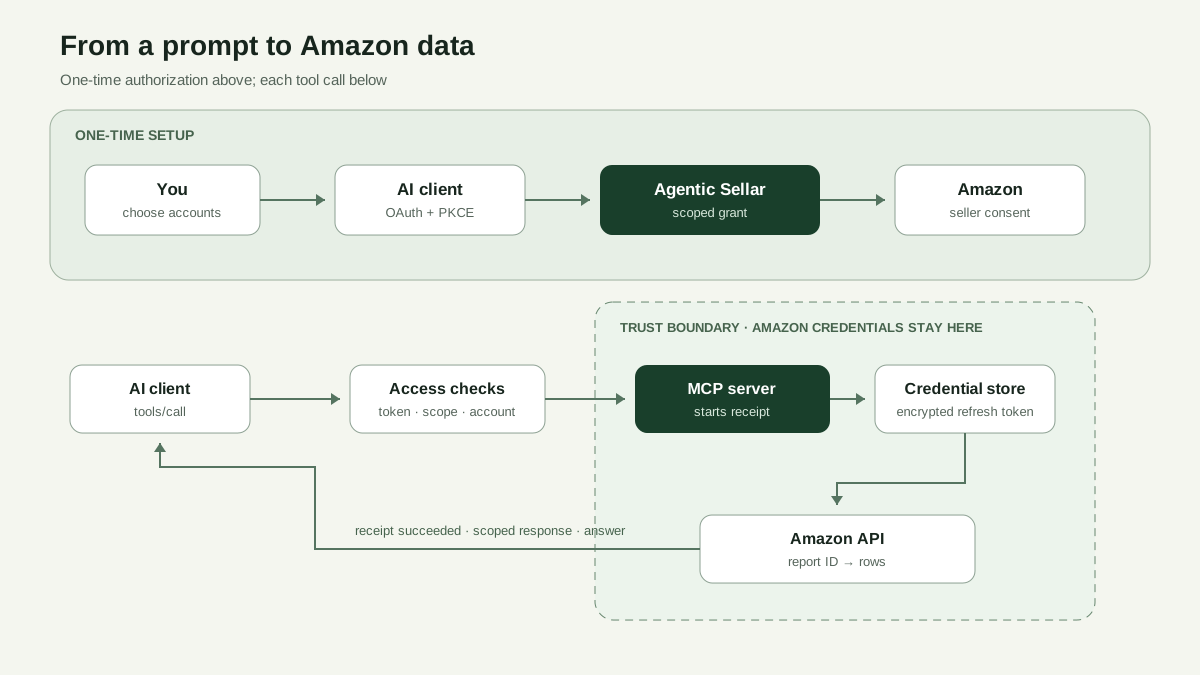
The AI client receives a token for Agentic Sellar, not an Amazon credential. Each call is checked, recorded and translated into the appropriate Amazon API request.
Your options in 2026
There are four ways to give an AI tool Seller Central or Amazon Ads access. None of them is right for everyone.
Build or run your own server
Open-source Selling Partner API and Ads API MCP servers exist, and you can write your own with an MCP SDK. You get full control over the tools and the data. You also take on Amazon's developer requirements:
- Register as a developer and get roles approved for the data you need. Amazon returns a 403 error when an application lacks the role for an operation.
- Store refresh tokens and client secrets securely. A local stdio server usually reads them from a configuration file on your machine.
- Keep up with API changes.
Amazon Ads MCP Server
Amazon opened the Amazon Ads MCP Server as an open beta on February 2, 2026. Amazon says it connects AI agents, including Claude, ChatGPT and Gemini, to Amazon Ads API functionality:
- creating, updating and deleting campaigns
- performance and reporting queries
- account-level settings
- billing data
It also offers pre-built tools for multi-step tasks. Amazon says the server is available to Amazon Ads partners with active API credentials. For advertising work it is the first-party option. It is built for the Amazon Ads API, and the announcement does not cover Selling Partner API data such as orders, FBA inventory or fees.
Amazon Selling Partner plugin
At Accelerate 2026, Amazon announced a Selling Partner plugin that brings Seller Assistant into Amazon Quick and, in beta, Claude. It is for sellers in Amazon's US stores. Amazon says the plugin connects listings, performance metrics, inventory and sales analytics, requires human approval for actions, and keeps audit trails. Amazon names Quick and Claude as the supported assistants, so if you use a different AI tool, check whether the plugin is available for it.
A managed Seller Central MCP server
A managed server, Agentic Sellar among them, is hosted by a third party. The provider is the registered Amazon application, and you authorize it once on Amazon's own consent screens. Your AI tool then connects to the provider over OAuth. The trade-offs: you trust the provider with your Amazon authorization, and coverage is whatever the provider has built. The checklist in the next section applies before you choose one.
| Route | Amazon APIs | Amazon authorization held by | AI tools | Good fit for |
|---|---|---|---|---|
| Self-built or open-source server | SP-API, Ads API or both | You | Any MCP client you configure | Developers who want full control and have, or will get, Amazon developer access |
| Amazon Ads MCP Server | Amazon Ads API | Your Amazon Ads API credentials | Claude, ChatGPT, Gemini and custom agents, per Amazon | Ads partners and developers focused on advertising |
| Amazon Selling Partner plugin | Seller Assistant: listings, inventory, sales | Amazon | Amazon Quick, and Claude in beta (US) | US sellers who want Amazon's assistant inside Quick or Claude |
| Managed server such as Agentic Sellar | SP-API and Ads API | The provider's server | OAuth-capable MCP clients | Sellers and agencies who want both data sets in their existing AI tool without building |
How to evaluate a Seller Central MCP server
Ask every server these questions, ours included. The third column gives Agentic Sellar's answers, including where it stops.
| Question | Why it matters | Agentic Sellar's answer |
|---|---|---|
| Where do the Amazon credentials live? | The Amazon refresh token is the most sensitive secret in the chain. | Amazon refresh tokens stay on Agentic Sellar's servers. AI clients get their own short-lived credentials. |
| How does the AI client sign in? | API keys pasted into client settings leak easily. | OAuth 2.1 authorization code flow with PKCE (S256) and dynamic client registration. There is no API key to paste. |
| Can you limit accounts and actions? | A connection should reach only what it needs. | A workspace owner picks the accounts. Separate read and write scopes cover Amazon Ads (ads:read, ads:write), Seller Central (seller:read, seller:write) and the workspace itself (workspace:read, workspace:write, for onboarding, billing and product settings). The consent screen shows whether the AI tool is asking for write access. |
| How are writes gated? | Client prompts vary. The server should enforce its own rules. | Every write needs a write scope and confirm=true, and write tools are marked destructive. Campaign archiving is left out of the curated tools because it cannot be undone. |
| Is there a record? | You need to know what ran, where and when. | A receipt for every call that passes access checks: operation, account, status and time. No report contents or tokens. |
| Is the data live or stored? | Freshness and history change the answer. | Live reads on every plan. Data plans add retained history. |
| What does it cover? | Tool lists vary widely. | Curated tools for Sponsored Products and common SP-API reads. General read and write tools reach other endpoints the connected application can access. |
| How do expiry and revocation work? | Old connections should not linger. | Access tokens last 60 minutes and refresh tokens rotate. A connection lasts at most 30 days and can be revoked at any time. |
| Which regions does it support? | Amazon runs separate North America, Europe and Far East endpoints. | All three, with one Amazon sign-in per region. |
| What are the rate limits? | A server should protect your account from runaway loops. | 120 tool calls per minute per workspace, shared by its AI connections, plus plan limits. Amazon's own throttling still applies. |
The details are in Agentic Sellar's agent access security model.
Limits that come with any Seller Central MCP server
- The model can be wrong. It can pick the wrong tool, misread a report or propose a change you would not make. Review every proposed write before you approve it.
- Amazon content is data, not instructions. Listing text, search terms and other content from Amazon can contain text that looks like instructions to the model. This is called prompt injection, and it is one more reason to check proposed writes.
- Amazon's own limits still apply. Report delays, attribution windows, throttling and role requirements carry through any MCP server.
- MCP does not create data. If Amazon's APIs do not expose something to the connected application, no MCP server can return it.
Agentic Sellar has limits of its own. It does not choose bids or budgets: changes come from your AI tool, and how that tool asks for approval depends on the client. Retained history starts when a Data plan begins collecting it, plus the history Amazon makes available (about 93 days for advertising reports). Agentic Sellar is independent and is not affiliated with or endorsed by Amazon, Anthropic or OpenAI.
Where Agentic Sellar fits
Agentic Sellar is a managed option for sellers and agencies who want Seller Central and Amazon Ads in the AI tool they already use. You don't need your own Amazon developer registration, a workspace owner decides which accounts each connection can use, and every write is gated by scope and explicit confirmation. If you only need advertising data and already hold Amazon Ads API partner credentials, Amazon's Ads MCP Server is worth evaluating too. Coverage, pricing and the security details are on the Amazon Seller Central MCP server page.
Sources
- Model Context Protocol specification (2025-11-25)
- MCP specification: Authorization
- MCP specification: Tools
- MCP specification: Transports
- What is the Selling Partner API?
- Authorize Selling Partner API applications
- Roles in the Selling Partner API
- Selling Partner API endpoints
- Amazon Ads MCP Server open beta announcement
- Amazon Ads API overview
- Amazon: Seller Assistant plugin for Amazon Quick and Anthropic's Claude